Exlex is built as educational project to test how much a DOD-based human readable configuration can achieve. its current features are:
- Zero copy immutable parser
- Native no_std support
- SIMD byte search via memchr on specific functions
- Supports modifying data and dumping it back into string (Arena mutator)
- Human readable format
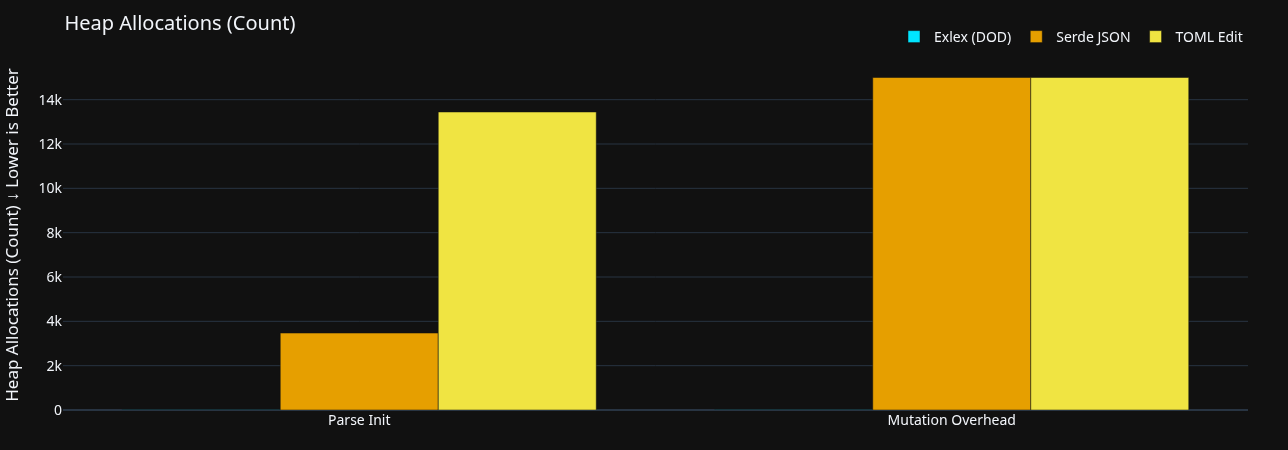
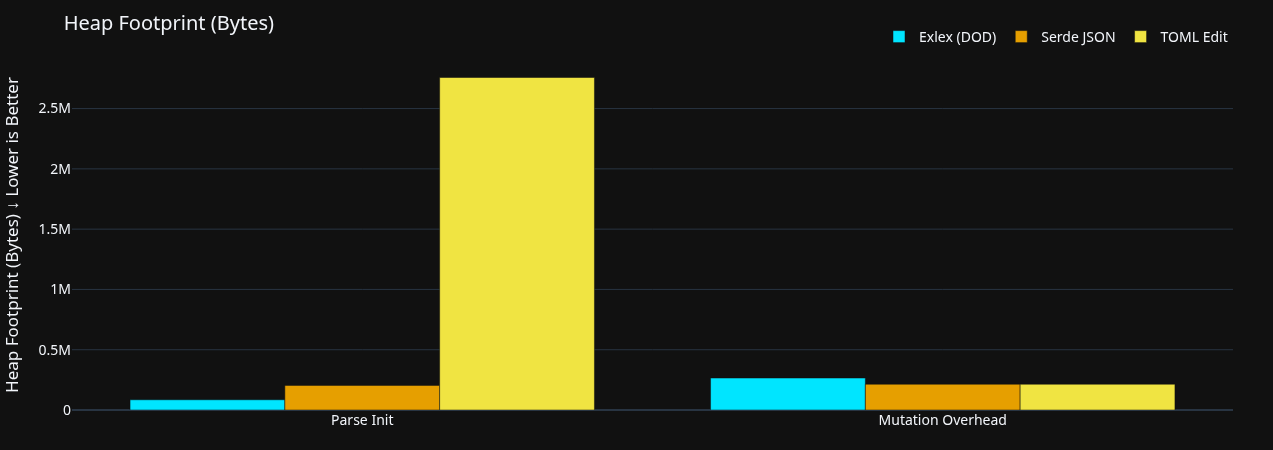
- Low memory usage even on mutations
Performance benchmarking
Some extra benchmark data used for testing purposes is available in Benchmarks.html file Due to lack of 1:1 direct competitor, I was forced to use toml_edit and others for baseline.
Note on Mutation Overhead: In the mutation graphs, Exlex takes a slight initial hit due to the preallocation of the String arena. However, on heavy or continuous mutation workloads.But scales significantly better and keeps allocations low.
 Exlex
Exlex
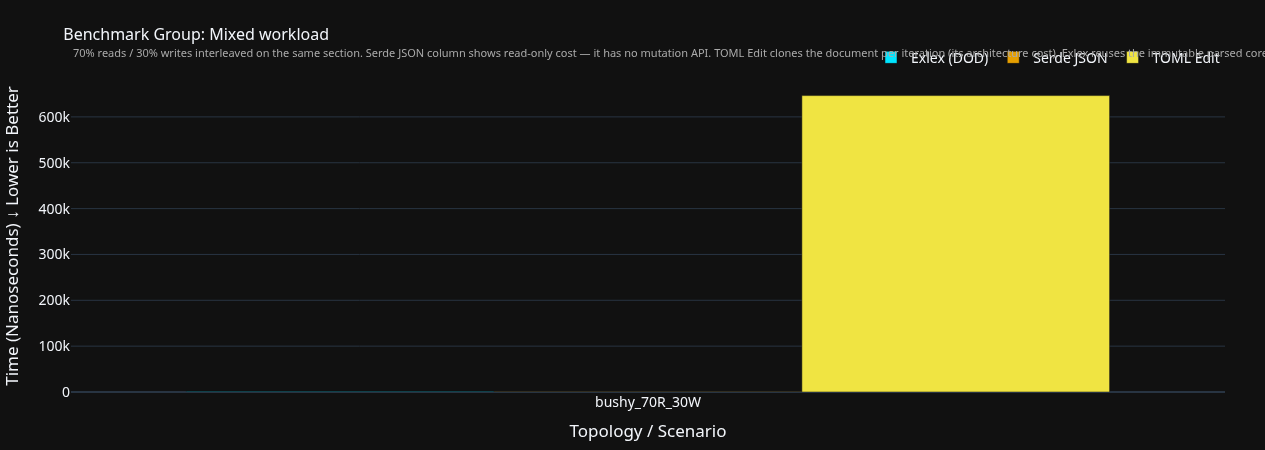
AI was strictly restricted to generating the benchmarking and testing suites. This allowed me to focus on hand-coding the actual parser and memory layout without spending days writing fuzzing boilerplate
Tradeoffs
- Currently the tradeoffs are slower retrieval compared to hashmap, when a section have more than 65 sections and 65 properties (Having lot of Properties won't affect speed of section retreival!)
- A need to follow rules of syntax (Performance above convenience)
- No inbuilt datatypes but arrays with string literal elements maybe achievable without sacrificing performance.
What it is and What it does not aim to be:
- Built for hardware constraint environment.
- Built to be Cache-friendly and Memory friendly as much as it can.
- Built for overall speed in lifecycle of a program (Parse -> Read -> Mutate -> Save).
- Syntax specifically designed to make parser fast while maintaining human readability
- It is NOT a feature rich or highly flexible syntax (Use json or toml if you need dynamic typing or complex data structures).
Issues
- Still in work in progress! (Expect bugs)
- Interface has a lot of work to do
- Docs are incomplete!
- Due to zero-copy architecture escape character has to be implemented
Parser and Mutator Stability
- Proptested
- Test file available at Exlex-Benchmark repo
~/Projects/exlex_bench main*
❯ PROPTEST_CASES=10000 cargo test proptest_mutator_engine --release

test result: ok. 0 passed; 0 failed; 0 ignored; 0 measured; 0 filtered out; finished in 0.00s

     Running tests/proptest_fuzz.rs (target/release/deps/proptest_fuzz-6b0455884b22cdc2)

running 1 test
test proptest_mutator_engine ... ok

test result: ok. 1 passed; 0 failed; 0 ignored; 0 measured; 2 filtered out; finished in 5.87s
Quick Start (Rust API)
Exlex splits its lifecycle into two different parts: an immutable, zero-copy Reader and an allocation efficient Mutator.
use exlex::{Exlex, ExlexArena};

fn main() {
    let config_data = r#"
    "name": "Exlex"
    "version": "1.0.0"

    sect "Server" {
        "host": "127.0.0.1"
        "port": "8080"
    }
    "#;

    // 1. Initialize the Zero-Copy Reader
    let exlex = Exlex::init_reader(config_data, None, None, None, None).unwrap();
    let root = exlex.get_root();

    // 2. Read Properties
    let name = exlex.get_property("name", root).unwrap();
    println!("Name: {}", name);

    // Retrieve typed properties from a nested section
    let server_sect = exlex.get_child("Server", root).unwrap();

    let port: u16 = exlex.get_property_as("port", server_sect).unwrap();

    // OR
    // As Server is first defined section (0 is reserved as ROOT)
    // let server_sect = ExlexSection(1);
    // Benefit of this method, Completely overrides Linear Search of Section getting O(1) retrieval for sections
    // let port: u16 = exlex.get_property_as("port", server_sect).unwrap();


    println!("Port: {}", port);

    // 3. Mutate Data (Arena-based)
    let mut arena = ExlexArena(String::new());
    let mut write_buffer = String::new();

    let mut mutator = exlex.init_mutator(&mut arena, &mut write_buffer).unwrap();

    // Update existing property
    mutator.update_prop("port", "9000", server_sect);

    // Add a new section and property
    mutator.new_section("Database", root).unwrap();
    let db_sect = exlex.get_child("Database", root).unwrap();
    mutator.update_prop("driver", "postgres", db_sect);

    // 4. Save to String
    mutator.save();
    println!("Updated Config:\n{}", write_buffer);
}
Syntax
# Comments were originally created so I can do some debugging
# All literals must be quoted!
"name": "Exlex"
"version": "1.0.0"

# A section can carry multiple properties and also supports nesting
# Each user defined structure in top to down order gets +1 section id that it can be used directly via ExlexSection(<id>)

# Section id: 1
sect "Server" {
    "host": "127.0.0.1"
    "port": "8080"
}

# Section id: 2
sect "Database" {
    "driver": "postgres"
    "pool": "32"

    # Section id: 3
    sect "ClientDB" {
        "host": "0.0.1"
        "port": "0980"
    }

    # Section id: 4
    sect "LoremIpsum" {
        "user": "user1"
        "auth": "userauth"
    }

    # Section id: 5
    sect "Credentials" {
        "user": "sys_admin"
        "auth": "ed25519"
    }
}

# Section id: 6
sect "Client" {
    "host": "127.0.0.1"
    "port": "8080"
}
Rules
To retain high performance for config files, the following rules are imposed by the parser:
- Quotes are enforced on all literals.
- All properties must be defined before defining a nested section in a scope.
Benchmark repo
There is a seperate repository that contains the boilerplate of criterion and proptest code if you want to check you can visit: https://github.com/cychronex-labs/Exlex-Benchmark